University of Cincinnati students use sound and virtual reality to improve drone reliability
Engineering doctoral students at UC are developing tools to detect mechanical faults in drones before flight and to automate warehouse inventory using digital twins.
By Luca Harrison ·
Sixty-five percent of warehouses in North America still rely on manual inventory processes, according to doctoral student Luke Busse. This statistic highlights a persistent inefficiency in logistics that University of Cincinnati engineering students are working to solve with autonomous drones. Their work, presented at the Modelling, Estimation and Control Conference in Phoenix, Ariz., this month, includes two distinct systems designed to enhance drone safety and operational accuracy in industrial settings.
One project focuses on detecting mechanical damage in drone components before takeoff. Doctoral student Prissha Chawla and her research partners recorded the specific sounds produced by drones when propellers are chipped or cracked or when motors begin to fail. The team converted these audio recordings into data that computers at a ground station can process. This allows operators to receive alerts that a drone is not airworthy before it leaves the ground. Chawla stated that the project began in 2024 with interest from NASA in detecting motor problems. She noted that drones are increasingly used for public safety, making it critical to prevent crashes caused by undetected mechanical issues.
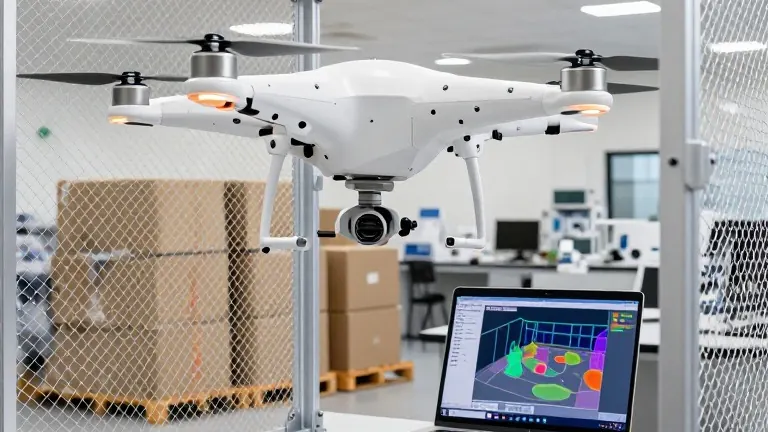
The second project addresses inventory management in large indoor spaces. Busse and doctoral student Deepak Antony David are collaborating with Valvoline to deploy drones that can log inventory and detect leaks from containers. These drones do not use satellite navigation. Instead, they rely on light detection and ranging, or LIDAR, to emit pulses of laser light for obstacle avoidance. The system achieves accuracy within centimeters. Busse explained that manual inventory often involves people picking products and categorizing them incorrectly. The drone system aims to reduce these errors by automating the process in tight warehouse aisles and high shelves.
The warehouse system utilizes a photorealistic model of the facility known as a digital twin. Workers can explore this virtual representation of the warehouse interior in high-definition video. By clicking on the virtual space, they can dispatch a physical drone to a specific aisle or section to perform tasks such as finding items or identifying damaged pallets. The virtual reality system runs on Unreal Engine software, the same platform used in popular video games like Fortnite and Batman: Arkham City. Busse described the experience as looking like a video game, with a live third-person perspective of the digital drone mirroring the real drone's movements in the physical space.
The students refined this system in the high-bay lab at UC’s Digital Futures. They set up a mock warehouse with pallets of empty boxes to test the drone's navigation capabilities. The drone captured the contours of the space using its LIDAR sensor and sent a real-time 3D rendering to a laptop. This setup allowed the team to verify that the drone could reach the highest shelves quickly without difficulty. The research was supported by UC’s Industry 4.0/5.0 Institute, which partners with companies to apply emerging technologies to practical problems.
The work was presented at the national conference sponsored in part by the UC College of Engineering and Applied Science. The projects represent a broader effort by engineering students to address reliability and efficiency in drone applications. Chawla mentioned that grit and debris can enter motor bearings, causing seizures, which the sound detection system is designed to identify. Busse added that the damage-detection system could be integrated into fully autonomous drone-in-a-box systems. In such scenarios, sensors in the docking station would provide preflight checks, allowing the drone to operate without an on-site operator for launch, landing, and charging.