Two Landmark Desert Rock Formations Collapse in New Mexico Amid Regional Storms
The loss of the Alien Throne and King of Wings formations comes as heavy rain and flooding damage communities and reshape landscapes across the Southwest.
By Takeshi Davidson ·
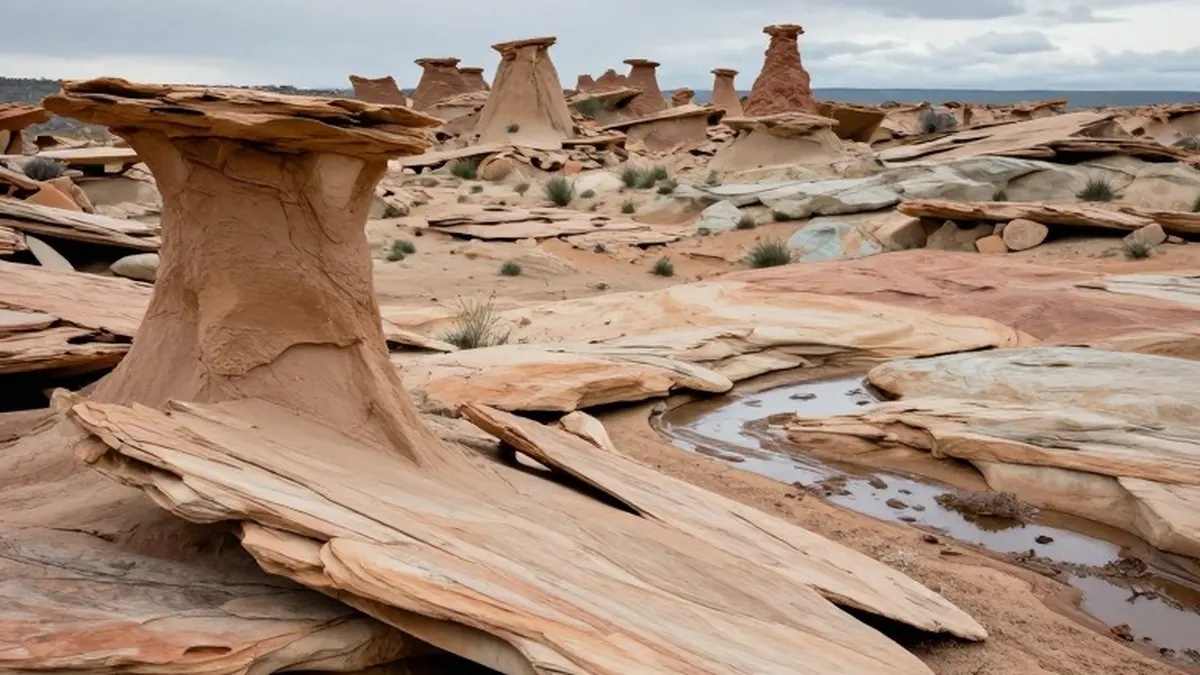
Two celebrated rock formations in northwestern New Mexico have collapsed within weeks of one another, leaving rubble where distinctive desert landmarks once drew visitors and photographers. The Alien Throne and nearby King of Wings succumbed to the natural forces that had gradually shaped them, as repeated storms battered the southwestern United States.
Kialo Winters, founder of Navajo Tours USA, discovered the fallen Alien Throne on Oct. 30 while guiding visitors near the edge of the Ah-Shi-Sle-Pah Wilderness. Poor road conditions had prevented him from returning for a couple of weeks, leaving the timing of its collapse uncertain. Known in his language as Tsé Bináká Níyol, the formation had been a familiar part of the homeland he shares with tour groups. “It was surreal,” he told The Associated Press.
Reports of the King of Wings collapse had begun appearing on social media in early October. Visitors photographed its broad rock slab lying beside the clay mound that once supported it. Both formations belonged to a landscape of precariously balanced rocks and intricately eroded sandstone, fashioned over time by wind and rain.
Recent storms have brought flooding to parts of New Mexico, Colorado, Utah and Arizona, with additional rain landing on soil already saturated during an unusually wet fall. Rivers have crested and normally dry washes have carried destructive floodwaters, damaging homes and wearing away the terrain. Experts estimate that more than 20 trillion gallons of rain fell across the Four Corners states and Nevada in late October and early November as tropical moisture moved into the region. Cleanup has begun as waters recede, but officials say damage could total hundreds of millions of dollars.
Winters remains worried about relatives on the Navajo Nation, where successive storm fronts left many dirt roads unusable or washed them away. The loss of the formations also carries cultural significance. For Native Americans in the region, such landmarks helped ancestors navigate trade routes over thousands of years and became part of stories passed between generations. Winters said photographs, illustrations and shared memories would preserve their legacies, and urged visitors to leave the remains undisturbed.
Online reactions included gratitude from people who had photographed the formations and disappointment from those who never saw them. Alan Studt of Parma, Ohio, visited in 2019 and returned last April during a 50-day road trip. Comparing photographs, he noticed additional holes in the Alien Throne and cracks near the base of the King of Wings.
Studt said those changes made their eventual collapse unsurprising. On his latest visit, he spent hours photographing and exploring the hills and washes, drawn onward by distant spires, petrified wood and varied soil colors. “It is really so magical to be out there,” he said.
More News · National news · Report a business · Got a Story?