Tesla Q3 Profit Slides as AI Spending Outpaces Revenue Growth
Margins recovered from Q2 lows, but operating income fell 56% year-over-year due to heavy investment in AI and new vehicle platforms.
By Mykola Bondarenko ·
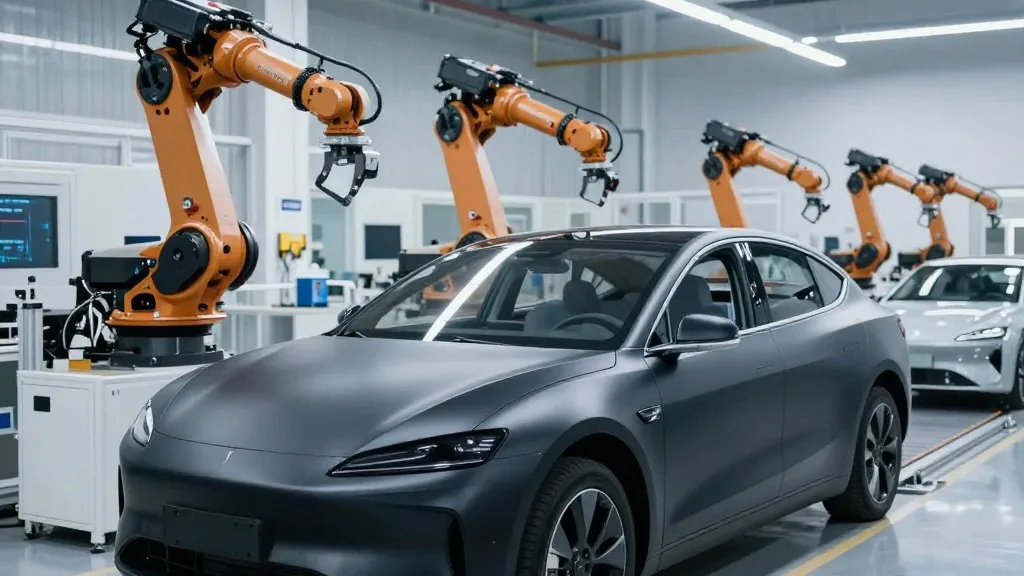
Tesla reported a 56% year-over-year decline in operating income for the third quarter, a result driven by aggressive spending on artificial intelligence and new vehicle models that outpaced its gross profit growth. The electric vehicle maker posted non-GAAP earnings of $0.48 per share, which beat the Wall Street consensus of $0.45 but remained down 4% from the same period last year. While total revenue held steady at $28.05 billion, the company’s bottom line was squeezed as operating expenses surged 39% to $4.78 billion.
The financial results, released after the market close on Tuesday, follow a turbulent second quarter when Tesla’s operating margin contracted to 1.4% and earnings per share missed analyst expectations by 20 cents. Investors were primarily focused on whether the company could arrest this downward trend in profitability. Although automotive gross margins excluding regulatory credits rebounded to 18.1% from 16.3% in the prior quarter, the broader operating picture remained under pressure. GAAP net income dropped 43% to $787 million, or $0.22 per share, reflecting the heavy weight of increased operational costs.
Tesla’s spending priorities have shifted significantly toward its "Super Intelligence" initiative, the Optimus robot, and the Cybercab. Research and development expenses jumped 69% to $2.76 billion, while stock-based compensation rose to $1.17 billion, up from $663 million a year earlier. Capital expenditures doubled to $4.73 billion compared to the same period last year. This heavy investment pace leaves the company with $13.01 billion in spending through the first nine months of 2026, roughly half of the "more than $25 billion" annual target management previously guided. To meet that goal, Tesla would need to spend approximately $12 billion in the fourth quarter alone, a figure more than double its highest previous quarterly capex.
On the revenue side, the energy division proved to be the weakest segment. Energy generation and storage revenue fell 16% to $2.88 billion, a decline Tesla attributed to tariff-related customer refunds, even as deployments increased 10% to 13.7 GWh. Conversely, the services segment, which includes charging, insurance, and parts, was the quarter's bright spot, with revenue growing 33% to $4.61 billion. Tesla noted that gross profit in this area hit a record $734 million. The company ended the quarter with $45.4 billion in cash and investments, and free cash flow stood at $1.53 billion, a significant improvement from the negative $1.09 billion recorded in Q2.
Management cited battery availability as the primary constraint on auto volume growth, stating that it limited the company's ability to increase production. Despite this supply-side explanation, average selling prices continued to fall, and deliveries dropped 2.1% year-over-year to 486,532 vehicles. Tesla reported a four-year high in passenger vehicle backlog, suggesting demand remains strong, yet the company delivered 22,141 more cars than it built, reducing inventory to 11 days of supply. Active FSD subscriptions reached 1.74 million, a 67% increase, while the Robotaxi service accumulated nearly 2 million unsupervised miles in the Austin fleet.
The company’s shareholder letter indicated that the improved automotive margins were driven by a better regional and product mix, along with increased FSD subscription revenue. Regulatory credits contributed only $113 million to revenue, down 73% from a year ago as the market for federal fuel-economy penalties has largely dried up. With the earnings call scheduled for 5:30 p.m. ET, management will provide further details on the company's strategic direction and the outlook for the remainder of the year, particularly regarding the pace of capital deployment in the final quarter.
Source: Electrek